Multiplication table for printing: why paper and generators are essential?
In the digital age, where children spend more and more time in front of smart screens, good old paper might seem like a relic of the past. However, neuroscientists, educators, and experienced parents agree: when it comes to consolidating fundamental mathematical knowledge, a printable multiplication table and physical tasks are an indispensable tool. On this page, you will find not only free PDF files but also smart generators that allow you to create endless unique tests.
Why does the paper table still reign?
Have you ever seen a child looking at a tablet but actually thinking about the game they will play later? Screens often distract attention. Paper provides calmness and focus. Here is why it is worth combining digital learning with printed material:
- Writing motor skillsWhen a child writes numbers by hand (instead of just pressing buttons on a screen), the part of the brain responsible for long-term memory is activated. This is called the "motor trace". By filling in a blank table by hand, information is memorized deeper, more accurately, and for a long time. This creates stronger neural connections than passive observation.
- Environment effectHung on a wall or refrigerator, a colorful multiplication table becomes a natural part of the home environment. The child sees it while eating, playing, or simply passing by. This is called passive learning – the brain "photographs" the image and memorizes the structure even when the child is not specifically studying.
Task generators: your secret weapon
One of the biggest problems with static workbooks is that children often memorize not the operation itself, but its location on the page or the sequence of answers. Our interactive task generators solve this problem once and for all.
Every time you press the "Generate" button, the system creates a completely new, unique test. This means the child will never solve the same sheet twice. We offer three different generator types tailored to the child's interests:
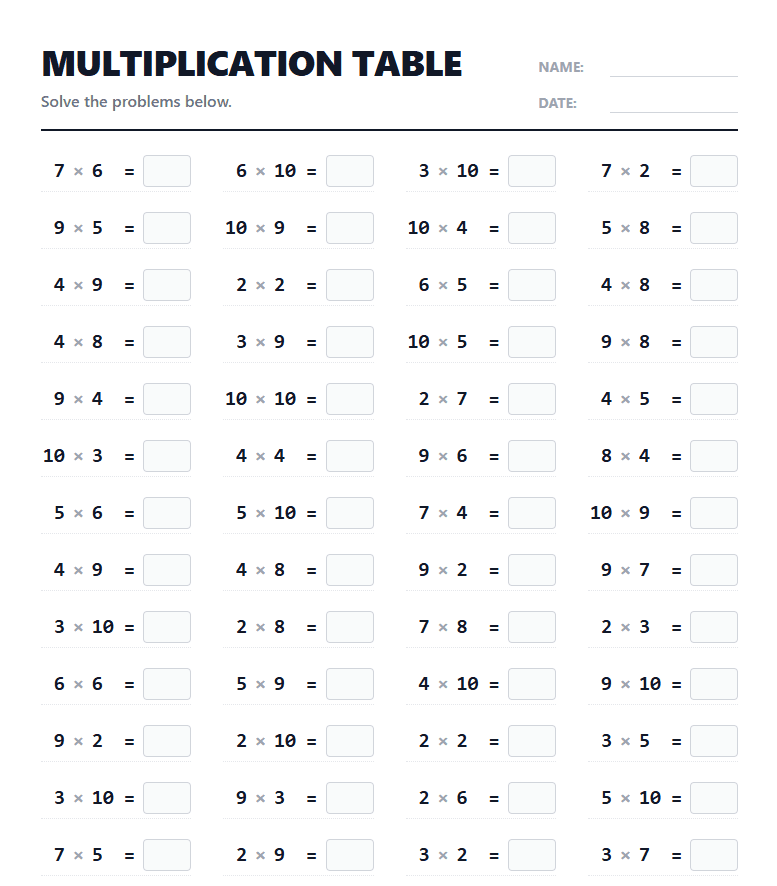
Standard generator
Classic, clean layout without distracting details. Perfect for serious concentration, simulating tests, and speed training. You can print the date and time to track progress.
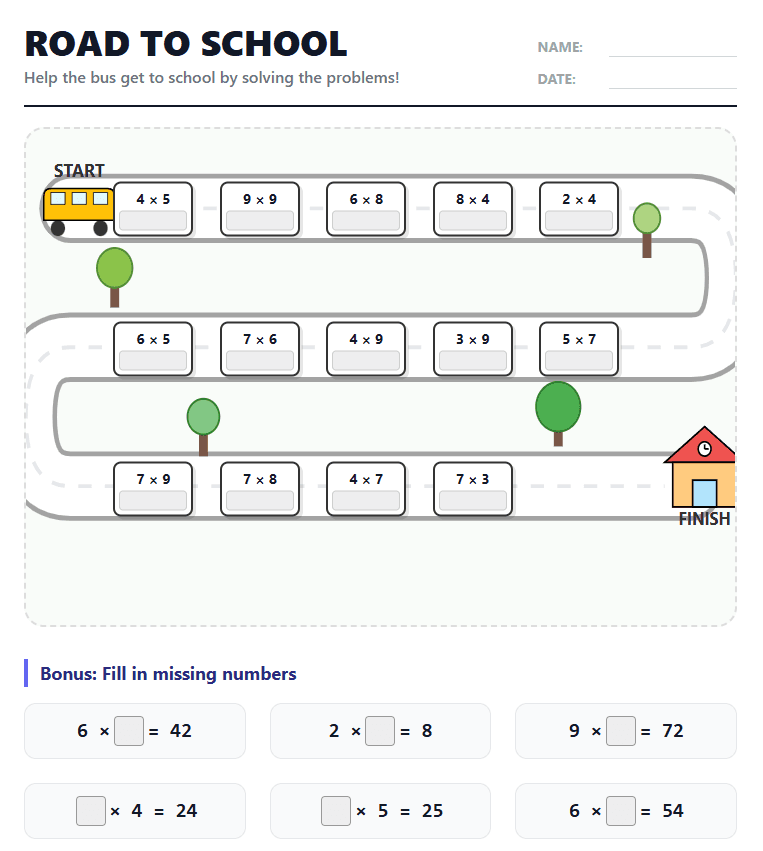
Road to school
Gamified version. The child must "drive" the bus to school by solving problems placed along a winding road. This creates a sense of purpose and turns homework into a small adventure.
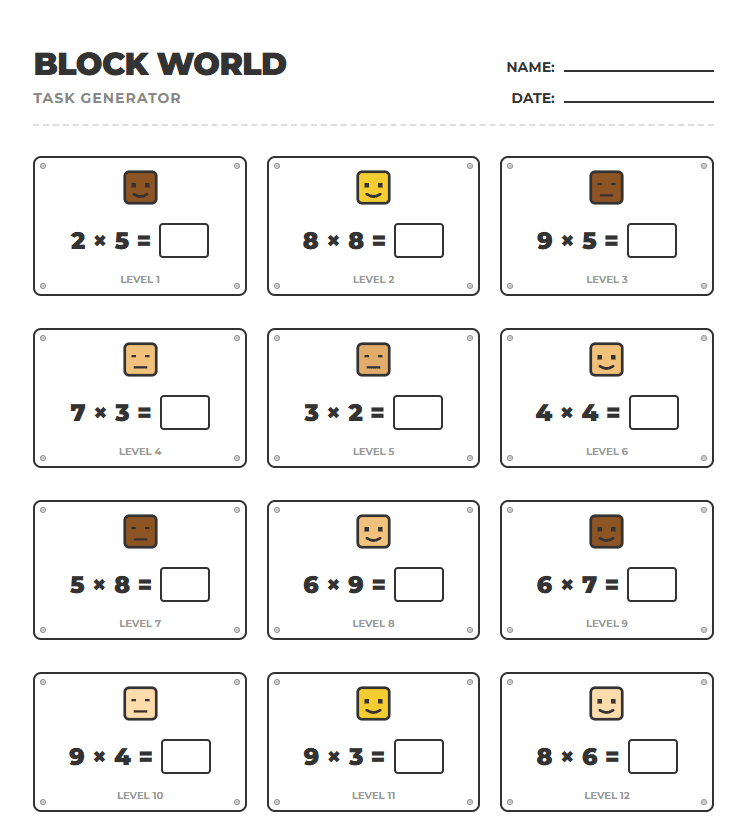
Block world
Specially designed for kids who love building games (e.g., Minecraft). Pixel graphics and character faces make math visually familiar and "their own".
Which PDF file to choose? Guide for parents
In our library, you will find different types of templates. Each is designed for a different learning stage. It is important to choose correctly so that the child does not lose motivation and feels confident.
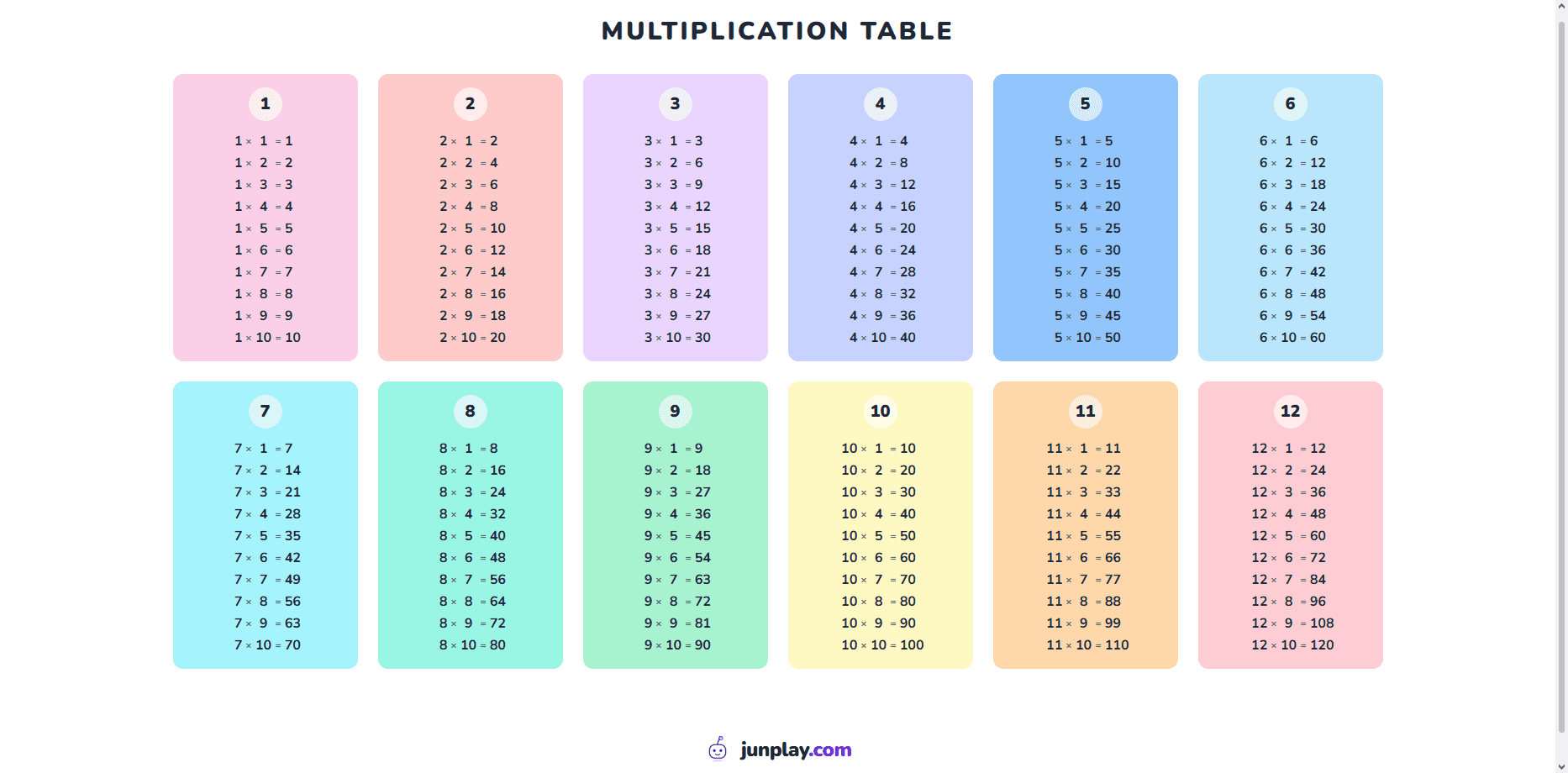
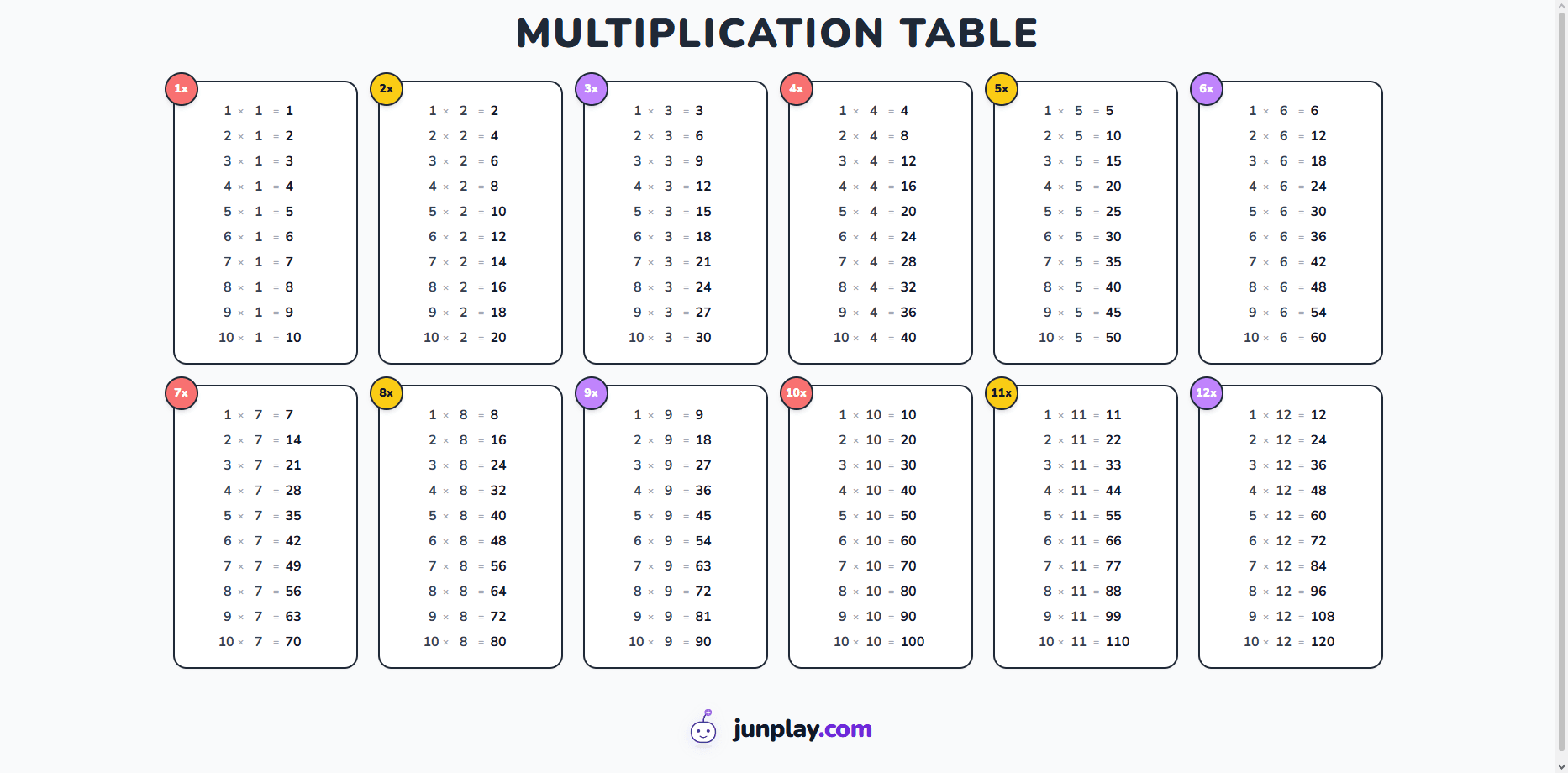
Classic or colorful table (A4)
When to use: In the initial stage. This is the child's "guide" and safety guarantee.
Tip: Print two copies. Put one in the notebook, hang the other above the desk. If the child is visual (memorizes images better), be sure to choose the Colorful table – different colors help distinguish number groups and find the required answer faster.
Pythagoras table
When to use: To understand patterns and logic.
This is not a simple list. It is a grid that shows mathematical symmetry. The child sees that 3×4 and 4×3 occupy the same place, just flipped. This cuts the learning load in half! Be sure to explain to the child how to use this grid (trace with a finger to the intersection).
Cutting cards
When to use: For active repetition and games.
Cards allow separating what the child already knows from what still needs to be learned. This creates a sense of "small victories" as the pile of "learned" cards grows.
Methodology: 7-day challenge with cards
Want to turn learning into a game? Print the "Cutting cards" file. Cut them out together with the child (this develops fine motor skills and lets the child feel part of the process!). Here is a simple but effective system for a week:
- Sorting: Ask the child to sort the cards into two piles: "I know perfectly" (answers faster than 3 sec.) and "Need to practice". Visually seeing that there are more "known" cards increases self-confidence.
- Daily limit: Take only 3-5 cards from the "Hard" pile for one day. No need to try to learn everything at once! You will achieve more with small steps.
- "War" game: Divide the cards in half. Both players flip one card. The one with the higher answer wins, but with an important condition – they take the card only if they say the answer aloud and correctly.
Synergy: how to combine paper and screen?
The best results are achieved by combining methods. Use paper tables for quiet evenings, homework preparation, and structured learning without distractions. And use our interactive game "Math Space" as a reward, speed training, and entertainment.
Paper provides deep understanding and calmness, while the computer game develops reaction, automatism, and excitement. When the child no longer thinks about the answer but simply "knows" it instantly – your goal is achieved.